There is a moment every smith knows.
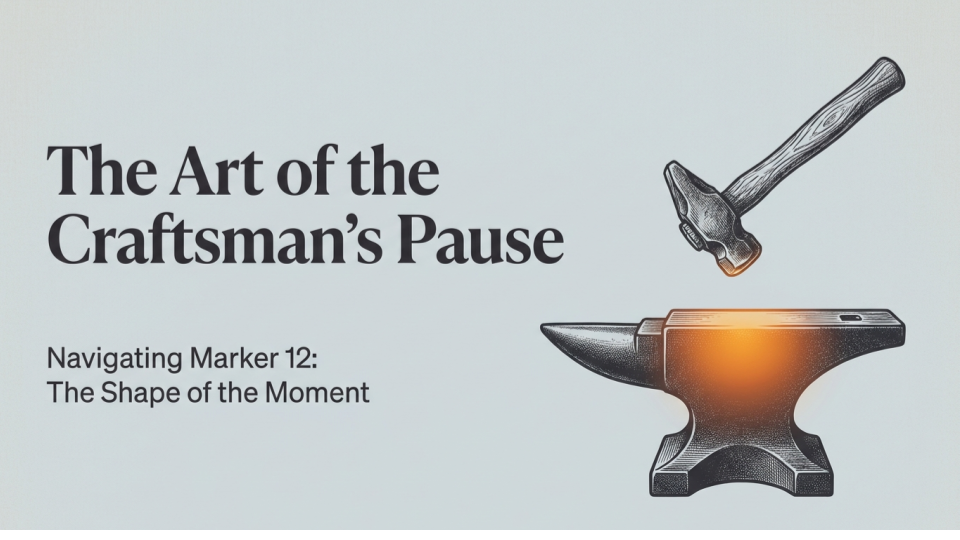
The hammer is raised. The metal is on the anvil. The fire has done its work — the steel is orange, almost white at the edges, soft enough to move. And then, before the blow lands, there is a pause.
Not hesitation. Not doubt.
Reading.
The craftsman reads the metal the way a navigator reads the sea. He is looking for the grain, the resistance, the place where the steel wants to go. He is asking a question the metal has already answered — he just needs to be still enough to hear it.
That pause is not wasted time. That pause is the work.
We live in a culture that has confused motion with progress.
We are told to move fast, to iterate, to ship, to hustle. The pause is treated as a failure of nerve — a sign that you don’t know what you’re doing, that you’re afraid, that you’ve lost momentum. The world rewards the person who swings first and asks questions later.
But the forge teaches something different.
Strike too soon, and you work against the metal. Strike too hard, and you crack what you were trying to shape. Strike without reading — without that moment of deliberate stillness — and you spend twice the effort correcting what a single pause would have prevented.
The 24 Markers are not a checklist. They are waypoints — places where the seeker is asked to stop and read the metal of their own life. Each Marker is a question the forge is asking. The work is not in answering quickly. The work is in being still enough to hear the question clearly.
There is a Marker that most seekers rush past.
It sits in the middle of the sequence, unremarkable at first glance. It asks, simply: What is the shape of this moment?
Not: What should I do next?
Not: How do I fix this?
Not: What does success look like from here?
Just: What is the shape of this moment?
It is the hardest question in the sequence, because it requires you to stop performing and start perceiving. It requires you to put down the hammer — not forever, not even for long — and simply read what is in front of you.
Most people never do this. They are so committed to the next swing that they never learn to read the metal. They work harder and harder on a piece that is telling them, clearly, that it needs something different. They mistake effort for craft.
The master craftsman knows the difference.
I have been at the bench long enough to understand that the pause is not passive.
When I raise the hammer and hold it — when I take that breath and look at the steel — I am doing the most active thing a craftsman can do. I am bringing everything I know to bear on a single question: Is this the right moment, and is this the right blow?
That question contains a lifetime of practice. It contains every mistake I’ve made, every piece I’ve ruined, every time I struck too soon or too hard or in the wrong direction. The pause is where all of that experience becomes useful.
Without the pause, experience is just history. With it, experience becomes wisdom.
The 24 Markers are structured around this rhythm.
Action and stillness. Striking and reading. Moving forward and stopping to ask what the metal is telling you. The sequence is not linear — it is cyclical, the way the forge is cyclical. You heat, you work, you quench, you examine. Then you heat again.
The seeker who rushes through the Markers is like the apprentice who keeps the hammer moving because stopping feels like failure. He is working hard. He is not forging well.
The seeker who honors the pauses — who sits with a Marker long enough to actually hear what it is asking — is doing the slower, harder, more important work. He is learning to read his own metal.
Here is what I have come to understand about the pause:
It is not the absence of action. It is the preparation for action.
The hammer raised is not a hammer at rest. It is a hammer in the moment before its most precise, most intentional, most effective strike. The pause is where the blow is aimed. The pause is where the craftsman decides not just where to strike, but whether to strike at all.
Sometimes the answer is: not yet.
Sometimes the metal needs more heat. Sometimes the piece needs to be repositioned. Sometimes the question you thought you were answering turns out to be the wrong question entirely, and the pause is what reveals that — before you’ve committed to a direction that would take twice the work to undo.
The forge does not reward impatience. It reveals it.
There is a phrase I return to often, one that has become something of a compass at the bench:
Nothing here was made fast.
Every ring in a chainmaille piece was closed by hand, one at a time. Every link was placed deliberately. The pattern emerged not from speed but from repetition — from the willingness to do the same careful motion ten thousand times without cutting corners.
The pause is part of that motion.
It is the breath between rings. The moment of checking the alignment before closing. The half-second where the craftsman confirms that this ring, this link, this choice — is the right one.
Remove the pause, and you have production. Keep the pause, and you have craft.
The 24 Markers ask you to be a craftsman of your own life.
Not a producer. Not an optimizer. Not a machine that converts effort into output.
A craftsman. Someone who reads the metal. Someone who knows when to strike and when to hold. Someone who understands that the pause is not a weakness — it is the signature of mastery.
The seeker who learns to pause — who learns to read the shape of the moment before committing to the next move — is the seeker who forges something that lasts.
The armor takes the shape of the work.
And the work begins with the pause.
One link at a time.
The 24 Markers of Grailness are the philosophical backbone of the Grail-Verse. They are not steps to be completed — they are waypoints to be revisited, each one revealing something different as the seeker grows. This essay explores Marker 12: The Shape of the Moment.